Our foam conversion process was hemorrhaging money. Every month, we were buying large foam blocks — 2m × 2m × 1m — and cutting them into sheets by hand. The problem was that manual peeling and splitting produced inconsistent thickness, excessive waste, and constant rework. We were losing an estimated 15% of our foam material to inaccurate cuts.
Two machines changed everything: the IF-FYQ1 Foam Peeling Machine for continuous roll foam processing, and the IF-FPQ1-1650 Horizontal Foam Cutting Machine for precision block slicing. Combined, they cut our foam waste by two-thirds and paid for themselves in under 5 months.
This is the exact story of how we fixed our foam sheet conversion — the numbers, the process, and the equipment choices that got us there.
Our factory produces polyurethane foam components for mattress manufacturers. We buy large foam blocks — typically 2,000mm × 2,000mm × 1,000mm — and convert them into sheets of various thicknesses, densities, and dimensions. Our customers need everything from 10mm thin sheets for mattress toppers to 150mm thick blocks for orthopedic bases.
For years, we did all of this conversion manually. A team of four operated a vertical band saw for splitting blocks into slabs, and two more workers used hand-guided electric knives for peeling thin sheets. The process was slow, dangerous, and wildly inconsistent:
We knew we needed better equipment. The question was: what combination of machines would solve all of these problems?
We installed the IF-FYQ1 Foam Peeling Machine first. Unlike a conventional cutting machine that slices through foam, the IF-FYQ1 works by peeling — it rotates a cylindrical foam block against a stationary blade, continuously peeling off a thin, uniform sheet, much like a lathe peels wood veneer.
This approach has a critical advantage: it produces continuous sheets of foam that are perfectly uniform in thickness. The peeling process eliminates the thickness variation problem entirely because the blade gap is mechanically fixed, and the rotating action distributes pressure evenly around the entire circumference of the foam block.
Here is what the IF-FYQ1 changed for us:
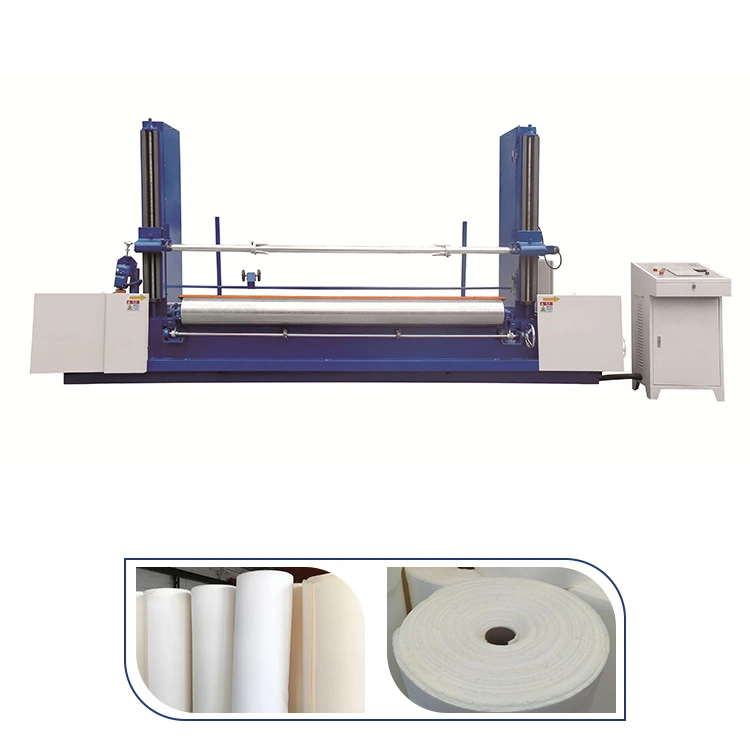
The IF-FYQ1 Foam Peeling Machine peels continuous uniform sheets from cylindrical foam blocks
The IF-FYQ1 solved our peeling needs, but we still had a problem slicing rectangular foam blocks into precision thickness slabs. The cylindrical peeling process is ideal for thin continuous sheets (2-30mm), but for thicker slabs (50-150mm) and rectangular blocks, a horizontal cutting machine is the right tool.
That is where the IF-FPQ1-1650 Horizontal Foam Cutting Machine came in. This machine uses a fully automatic digital control system: the operator sets the desired cutting thickness on the control panel, and the worktable automatically moves the foam block through the cutting blade at the programmed depth.
| Cutting Capacity | 1650mm or 2150mm width options — matches standard foam block sizes |
| Control | Fully automatic digital control — set thickness on the control box, machine does the rest |
| Thickness Range | 3mm to 500mm per slice — handles everything from thin laminates to thick support blocks |
| Precision | ±1mm thickness accuracy on all cuts — consistent even with varying foam density |
| Density Handling | Cuts foam densities from 8 to 80 kg/m³ — from soft cushion foam to rigid support |
The IF-FPQ1-1650 replaced our old vertical band saw entirely. The digital control system means the operator does not need to measure and mark the foam block — just punch in the desired thickness, and the machine indexes the worktable automatically for each cut. A full 2m block cut into 50mm slabs takes about 15 minutes of machine time, with the operator loading the next block during the cut cycle.
The waste reduction was immediate: our material waste rate dropped from 15% to 4.8% in the first month. By month three, with the operators fully trained, waste settled at 3.2% — a 79% reduction in foam waste.

The IF-FPQ1-1650 cuts foam blocks to exact thickness with ±1mm accuracy
A common question we get: why not just buy one machine that does everything? The answer is that foam peeling and foam horizontal cutting serve different purposes in a production line, and having both gives us full flexibility to handle any customer requirement.
Here is how we split the work between the two machines:
In practice, about 60% of our volume goes through the IF-FPQ1-1650 (slabs and sheets for mattress production), and 40% through the IF-FYQ1 (continuous topper rolls and specialty thin-gauge products). The machines run simultaneously with two operators, producing about 3× the output of our previous four-person manual team.
| Metric | Before (Manual) | After (FYQ1 + FPQ1) |
|---|---|---|
| Foam material waste rate | 15% | 3.2% |
| Annual foam waste cost | $58,500 | $12,500 |
| Workers per shift (foam conversion) | 6 | 2 |
| Annual labor cost | $86,400 | $28,800 |
| Sheet thickness accuracy | ±3-6mm | ±0.5-1mm |
| Maximum sheet length | 2m (single block) | 50m (continuous) |
Total annual savings from waste reduction: $46,000. Annual labor savings: $57,600. Combined investment for both machines: approximately $35,000 delivered and installed. Net first-year savings: $68,600. Payback: 5.1 months.
Based on our experience, here are the three machines every foam conversion operation should consider. The first two are what we run every day. The third is the natural upgrade for factories ready to automate their foam handling further.
1. Peeling and horizontal cutting are complementary, not competing. Before buying, we wondered whether we could get away with just one machine. The answer was no — at least not for a factory that serves both thin-sheet and thick-slab markets. The IF-FYQ1 Peeling Machine is unstoppable for thin continuous sheets, but it cannot cut thick slabs. The IF-FPQ1-1650 handles thick slabs beautifully, but it cannot create 50m continuous rolls. You need both if you serve a diverse customer base.
2. Digital control eliminates the skill gap. Our manual cutting operation relied heavily on experienced cutters who had developed an intuitive feel for blade speed and pressure against different foam densities. When those workers left, output suffered. The IF-FPQ1-1650's digital control panel makes thickness setting foolproof — any operator can achieve ±1mm accuracy after a day of training.
3. Foam waste reduction is immediate and measurable. We tracked our waste rate weekly after installing both machines. It dropped from 15% to under 5% in the first month — not because the machines are magical, but because they eliminate human error from the measurement and cutting process. The IF-FYQ1's peeling blade produces zero kerf waste (no material lost to the cut width), and the IF-FPQ1-1650's digital indexing ensures every slice is exactly where it should be.
4. Your next step after peeling and slicing: profile cutting. Once you have consistent flat sheets, the next bottleneck is shaping those sheets into finished profiles. The IF-FYP6 Carrousel Splitting Foam Cutting Machine is the logical next investment — it handles multi-block profile cutting with the same digital precision and dramatically expands the range of products you can offer.
If any of these sound like your operation, it is time to look at the IF-FYQ1 Foam Peeling Machine and IF-FPQ1-1650 Foam Cutting Machine:
The IF-FYQ1 and IF-FPQ1-1650 together cost less than one year of foam waste and excess labor in a typical mid-size foam conversion operation. If your monthly foam spend is above $20,000, the math almost certainly works in your favor.
Before we invested in the IF-FYQ1 and IF-FPQ1-1650, foam sheet conversion was our most frustrating process. We were wasting material, paying too many people to do inaccurate work, and limiting our product range to what our manual cutting setup could handle.
Now, a two-person team runs a conversion line that produces three times the output of our previous six-person crew — with better accuracy, less waste, and zero customer complaints about sheet dimensions. The equipment paid for itself in five months. Everything after that is pure margin improvement.
If you are still converting foam blocks by hand, or relying on outdated cutting equipment, the IF-FYQ1 and IF-FPQ1-1650 are the most impactful investments you can make. They are not expensive — they are profitable from day one.
Our engineers can help you select the right foam peeling and cutting combination for your specific production needs. Get a customized ROI projection for your factory.


