If you run a quilting machine in your mattress factory, you know the moment the fabric rolls off the needle bed, things get chaotic. Two workers grab the heavy quilted panel, wrestle it onto a table, try to fold it neatly, and stack it without creasing or stretching. Every minute of that manual handling is a minute your quilting machine sits idle. And every crease, fold mark, or fabric scratch is a potential reject. The IF-QFS Automatic Quilted Fabric Stacking Machine was designed to solve exactly this problem — turning the most labor-intensive step in your quilting line into a fully automated, hands-free operation.
Most mattress factories focus their automation investment on the quilting machine itself — and rightfully so. A computerized multi-needle quilting machine like the IF-Q-1200 can produce 40-60 meters of quilted fabric per hour. But what happens in the 30 seconds after the fabric leaves the machine? In too many factories, the answer is: two workers manually grab, fold, and stack each panel. That manual bottleneck creates three expensive problems.
Problem 1: Quilting Machine Downtime. When your stacking team falls behind, the quilting machine must pause. Even a 2-minute stop every 10 panels means you lose 12 minutes per hour — that's 20% of your quilting capacity sitting idle. At a production rate of 50 panels per shift, you're losing the equivalent of an entire hour of quilting output every single day.
Problem 2: Fabric Damage from Handling. Quilted fabric is delicate. The batting layer inside can shift, the surface pattern can stretch, and corners can fold sharply — all from rough manual handling. Industry data shows that manual stacking causes 2-4% fabric damage rate. On a 50-panel shift with each panel worth $15-25 in material, that's $15-50 in daily waste. Over a year, a single factory can lose $4,000-$12,000 in damaged fabric alone.
Problem 3: Labor Dependency. Manual stacking requires 2 dedicated workers per shift. At an average wage of $800-1,200/month per worker in manufacturing regions, that's $1,600-2,400/month in labor costs dedicated to a task that a machine can do better, faster, and without breaks.
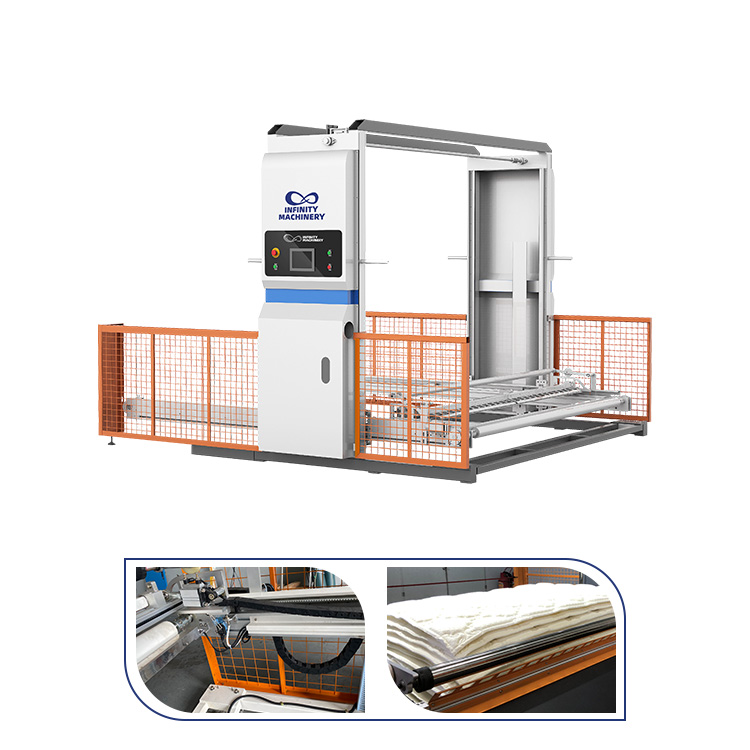
Model: IF-QFS
Fully automatic quilted fabric stacking with precision alignment, gentle handling, and adjustable stack height. Eliminates manual labor at the post-quilting stage.
The IF-QFS integrates directly into your quilting line, positioned immediately after the quilting machine output. The workflow is simple but precise:
Step 1: Automatic Fabric Reception. As quilted fabric exits the quilting machine, the IF-QFS receives it on a conveyor-guided system. Sensors detect the fabric edge and ensure proper alignment before the stacking process begins. There is no manual intervention required — the machine handles the transition from quilting to stacking autonomously.
Step 2: Precision Cutting to Length. The built-in cutting system slices the continuous quilted fabric into predetermined panel lengths. This is controlled by the machine's digital system, so each panel is cut to the exact dimension needed for your mattress size — whether you're producing single, queen, or king panels. The cutting accuracy ensures minimal fabric waste at the edges.
Step 3: Automated Folding and Stacking. After cutting, the IF-QFS automatically folds the panel and places it onto the stacking platform. The folding mechanism uses gentle pressure to avoid creasing the batting layer. Each panel is placed precisely on top of the previous one, creating neat, uniform stacks ready for the next production stage — whether that's the sewing station or direct assembly.
Step 4: Stack Height Management. The machine counts panels and signals when a stack reaches the preset height. An operator can then remove the completed stack and the machine continues with the next batch — all without stopping the quilting line.
Let's calculate the actual return on investment for a factory producing 50 quilted panels per 8-hour shift:
| Cost Category | Before IF-QFS | After IF-QFS | Monthly Savings |
|---|---|---|---|
| Stacking Labor (2 workers) | $2,000 | $400 (1 part-time) | $1,600 |
| Fabric Waste (damage) | $600 | $30 | $570 |
| Quilting Downtime Loss | $400 | $0 | $400 |
| Total Monthly Savings | $2,570 |
At $2,570 in monthly savings, the IF-QFS pays for itself within 4-6 months. After that, every month is pure profit improvement. Over a 5-year machine lifespan, the total savings exceed $150,000 — and that's before accounting for the improved product quality and customer satisfaction that comes from consistently flawless quilted panels.
Consider what a typical production day looks like with and without the IF-QFS:
Manual Stacking Day: The shift starts at 8:00 AM. By 8:15, the first quilted panels are coming off the machine. Two workers grab them, fold them, and stack them. By 10:00 AM, the workers are already behind — the quilting machine runs at 50 panels/hour, but the team can only stack 35 panels/hour. The line supervisor tells the quilting operator to slow down. Production drops to 35 panels/hour. By 2:00 PM, one worker takes a break and the other struggles alone — three panels get creased and set aside as rejects. The shift ends at 4:00 PM with 260 panels stacked, 8 panels rejected, and two exhausted workers.
IF-QFS Automated Day: The shift starts at 8:00 AM. The quilting machine runs at full speed — 50 panels/hour — with the IF-QFS handling every panel as it comes off the line. The single operator monitors the stack height and removes completed stacks every 45 minutes. No slowdowns, no pauses, no rejected panels from handling damage. By 4:00 PM, the shift produces 400 panels — all perfectly stacked, zero damage, ready for the next stage.
That's a 54% increase in daily output from the same quilting machine, same shift hours, same raw materials. The only change is eliminating the manual stacking bottleneck.
| Model | IF-QFS |
| Function | Automatic quilted fabric stacking and panel cutting |
| Control System | Digital PLC with touchscreen interface |
| Cutting Accuracy | ±2mm panel length tolerance |
| Stack Height | Adjustable up to 100 panels per stack |
| Fabric Width | Up to 2500mm (compatible with standard quilting machines) |
| Production Speed | Matches quilting machine output — no bottleneck |
| Power Requirement | Standard 380V industrial power supply |
One of the most common concerns we hear from factory owners is: "Will this work with my current quilting machine?" The answer is yes. The IF-QFS is designed as a universal post-quilting solution that integrates with any brand of multi-needle quilting machine. Whether you operate an IF-Q-1200, an IF-QM1-4 lock stitch machine, or a competitor's model, the IF-QFS connects seamlessly.
The installation typically takes less than one working day. Our technical team provides on-site setup, calibration, and operator training. The machine's footprint is compact — roughly 3m x 2m — so it fits into most existing factory layouts without requiring floor plan redesign.
For factories that also use a panel cutter, the IF-QFS can be positioned upstream — stacking first, then feeding into the cutter for final sizing. This two-stage approach gives you maximum flexibility in your production flow.
Compact 3m x 2m footprint. Fits alongside your existing quilting machine without layout changes.
Standard 380V three-phase industrial power. No special electrical work required.
Under 1 working day. Includes setup, calibration, and operator training.
Touchscreen interface with intuitive controls. Most operators master it within 2 hours.
For factories looking to build a complete, automated quilting line, we recommend combining three machines that work in sequence:
Stage 1: Quilting. The IF-Q-1200 Computerized Chain Stitch Quilting Machine produces high-quality quilted fabric at speeds up to 50 meters per hour. Its multi-needle design creates consistent patterns across the full fabric width, and the computerized control allows quick pattern changes between production runs.
Stage 2: Stacking. The IF-QFS Automatic Stacking Machine receives the quilted fabric, cuts it to length, and stacks panels automatically — eliminating the manual handling bottleneck.
Stage 3: Panel Cutting. The stacked panels feed into a panel cutter for final precision sizing before they move to the sewing and tape edge stations.

Model: IF-QM1-4
Alternative quilting option with lock stitch technology. Ideal for factories that need reversible quilted fabric or higher stitch durability.
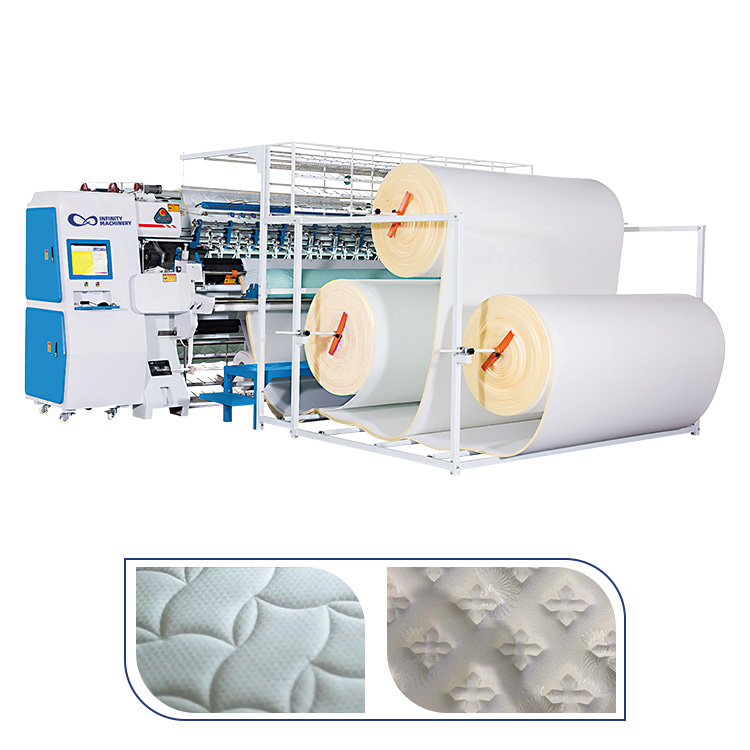
Model: IF-Q-1200
High-speed multi-needle quilting with computerized pattern control. The perfect partner for the IF-QFS stacking system.
Infinity Mattress Machinery has been supplying quilting equipment to mattress factories worldwide for over 15 years. Our quilting line solutions — from the IF-Q-1200 quilting machine to the IF-QFS stacking system — are installed in factories across Southeast Asia, the Middle East, Africa, and South America. Every machine is built in our Guangzhou facility with ISO 9001 quality management and carries CE certification for international compliance.
When you invest in an IF-QFS, you're not just buying a machine — you're getting a complete automation partner. Our team provides pre-installation consultation to assess your factory layout, on-site installation and calibration, operator training, and ongoing technical support. We understand that in mattress manufacturing, every hour of downtime costs money, so our response times and parts availability are designed to keep your line running.
Ready to eliminate the stacking bottleneck in your quilting line? Request a technical consultation to see how the IF-QFS fits into your specific production setup.
Get a free technical consultation and factory layout assessment for the IF-QFS stacking system.

