
If you buy ready-made spring units and quilted panels, start with suppliers that can close the mattress and pack it for your sales channel. Infinity Mattress Machinery and Mert Makina both merit a look for a linked finishing line. If quilting limits output, compare the panel you can make on a Gribetz machine with the cost of a complete panel line. For a pocket spring factory, the more useful comparison is how Spühl and Lianrou join rows into a core.
Two factories selling the same queen-size hybrid may need entirely different equipment because one buys components and the other makes them. Decide where bought-in materials enter your floor and what has to leave it before you compare quotations.
Infinity Mattress Machinery publishes this guide and appears first as a supplier of multi-station projects. For a single operation, the relevant comparison is between suppliers that can make the same part or package.
How to evaluate a mattress machinery supplier
Compare suppliers on a job your factory runs. For a tape edge machine, that might be a thick pillow top with a soft border that shifts on the turn. For a packer, it might be the firmest king mattress that has to fit your current carton. Agree on what the finished piece must look like before anyone demonstrates the machine.
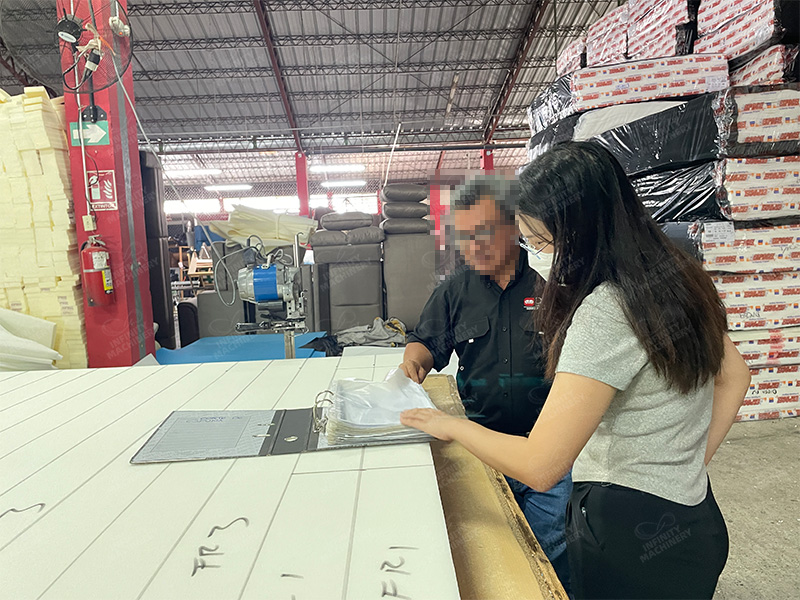
| What to evaluate | Evidence to request | What it decides |
|---|---|---|
| Product and process fit | A run with your actual layer stack, wire, adhesive or film and the drawing of the finished item. | Whether the quoted configuration can make the model you sell. |
| Sustained output | Accepted units over a timed run, with operators, changeovers and rework recorded. | Whether the station meets the shift target at the normal staffing level. |
| Scope and integration | A dimensioned layout naming the builder of each station, transfer, guard and control interface. | Who owns the gaps between one machine and the next. |
| Safety and documentation | Model-specific drawings, instructions and applicable conformity documents for the installation market. | Whether the installation and maintenance teams have the evidence they need. |
| Service and prior installations | A comparable commissioning record and a support route for your shift, with stock locations for critical parts. | How the plant will get back into production after a fault. |
| Delivered and running cost | An itemized delivery and installation offer, plus measured consumables per accepted unit. | Which offer costs less for the same operating result. |
To score competing bids for the same job, give each item 0 for missing evidence, 1 for a written commitment and 2 for evidence you have checked. If the machine cannot handle your thickest model, or the supplier cannot identify who takes responsibility for guarding a transfer, leave that issue open for resolution before comparing totals. Specify a different configuration or exclude the oversized model from the quoted scope.
15 mattress machinery suppliers at a glance
Specify what goes into the machine and what comes out. An Amelco roll baler packs bare spring cores for another factory. A Dolphin Pack or C³ system rolls finished mattresses for retail shipment. All three might appear in a search for a mattress packing machine.
The equipment column names a model or system described in each supplier's own product literature. Masias describes its wadding line by process, so that entry has no model number. We chose these examples to show what each supplier can make. The last column gives our reasons for shortlisting a supplier for a particular job.
| Supplier | Base | Documented model or system | When it belongs on the shortlist |
|---|---|---|---|
| Infinity Mattress Machinery | Guangzhou, China | IF-T4 automatic mattress tape edge machine | Your project combines closing and packing. Infinity commissioned both in its Mexico installation. |
| Mert Makina | Kayseri, Türkiye | M-2800 automatic tape edge and packaging line | Mattresses must turn or cross between existing stations. |
| Hennecke | Sankt Augustin, Germany | JFLEX EVO continuous slabstock line | You intend to produce foam blocks in-house. |
| Bäumer | Freudenberg, Germany | OFS-Queensize horizontal contour cutter | Your block width and order mix justify a wide contour cutter. |
| Masias Maquinaria | Sant Joan les Fonts, Spain | Felt and wadding lines with direct feed to a multi-needle quilter | You want to make quilt fill from fiber blends. |
| Spühl | Wittenbach, Switzerland | Fides FPA-300 pocket spring assembler | Existing spring strings must become glued, potentially zoned cores. |
| Lianrou | Guangzhou, China | LR-PSA-GLL glue-free pocket unit line | The spring design specifies welded row joints. |
| Belmac | Forlì, Italy | BM 100 Bonnell coiler | You make open-coil units and need individual knotted springs. |
| Amelco Industries | Strovolos, Cyprus | RL2000PRE innerspring unit baler | You ship unfinished spring units in bulk between factories. |
| Gribetz | Fort Lauderdale, USA | Paragon M+ multi-needle quilter | Pattern mix and quilted width drive panel economics. |
| Atlanta Attachment Company | Lawrenceville, USA | Handle-making workstation (model 1959) and border handle tacker (model 1353M) | Handle preparation or attachment is slowing the border room. |
| MPT Group | United Kingdom | BordaTac S4 side stitcher and Autotufter tufting machine | You need a decorative side stitch or a through-tufted construction. |
| Elektroteks | Bursa, Türkiye | WBX-400 Series water-based roll-coating system | You need to meter adhesive across different foam layers. |
| Dolphin Pack | Affi, Italy | Ander Roll roller and Pressa + Ander Roll compression-and-rolling system | An operator can pre-bag the mattress or topper before rolling. |
| C³ Corporation | Wisconsin, USA | CF1396 compression folding system | The same plant ships bagged beds and folded, rolled cartons. |
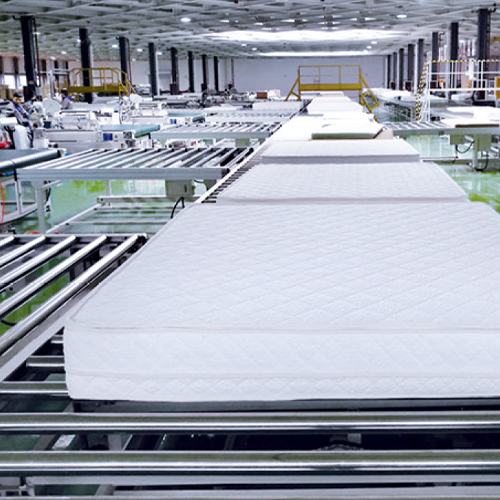
Supplier profiles and where each one fits
1. Infinity Mattress Machinery
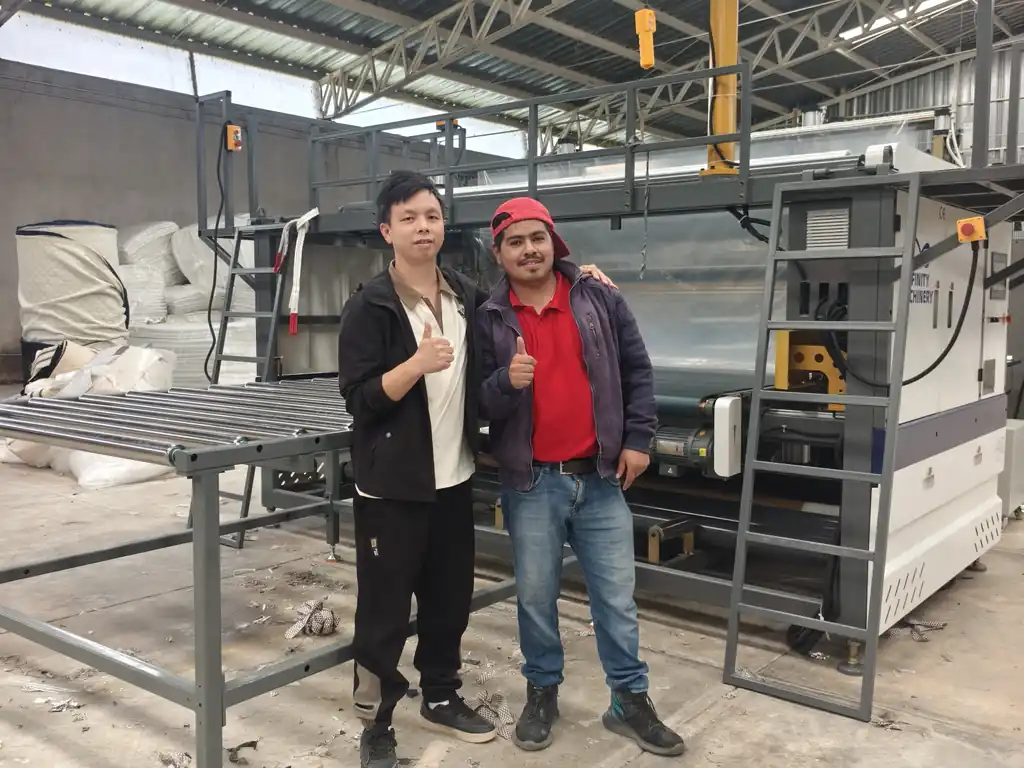
Infinity in Guangzhou, China, is a practical starting point for a factory that needs one team to lay out adjacent stations. In August 2026, our technicians installed hemming, tape edge and mattress packing equipment in Mexico. The customer already had a product to finish. The job was to prepare its textile edges, close the mattress and get it through packing in the same workshop.
The team spent the first day checking the floor and connections. After assembly and leveling, the technicians set sewing speed, presser-foot pressure and table height for the customer's fabric and tape. Operators ran their own materials on day four. On day five the factory took over with the manuals and maintenance checklist. Those five days began on the factory floor, after the equipment had arrived. See the Mexico installation.
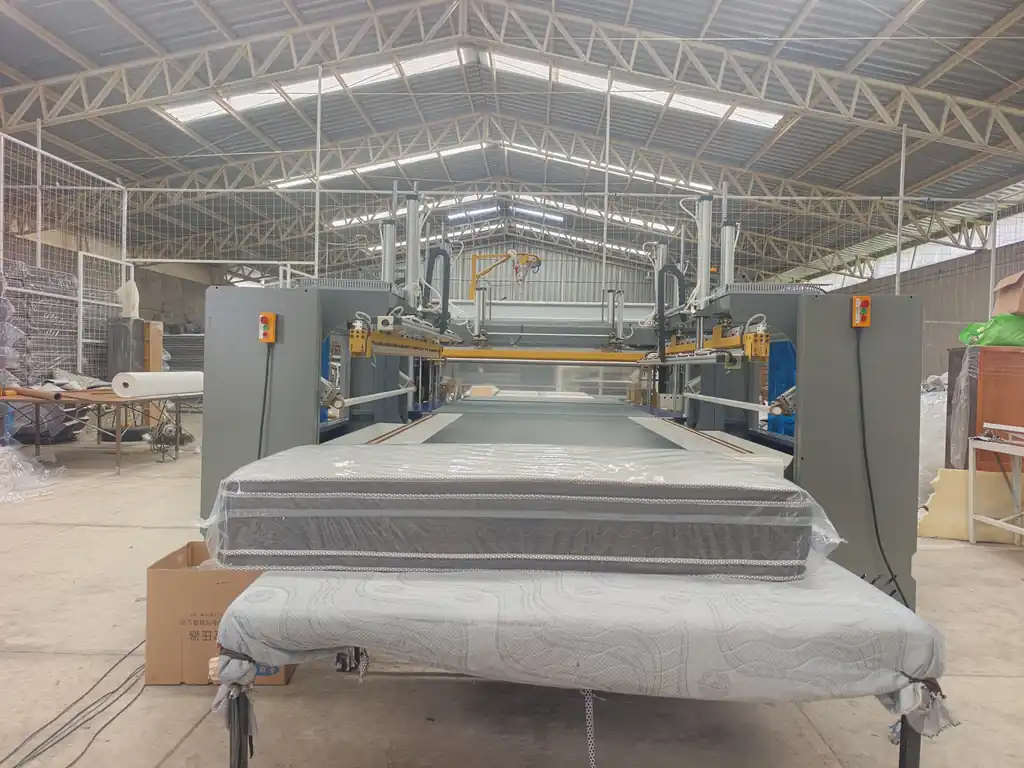
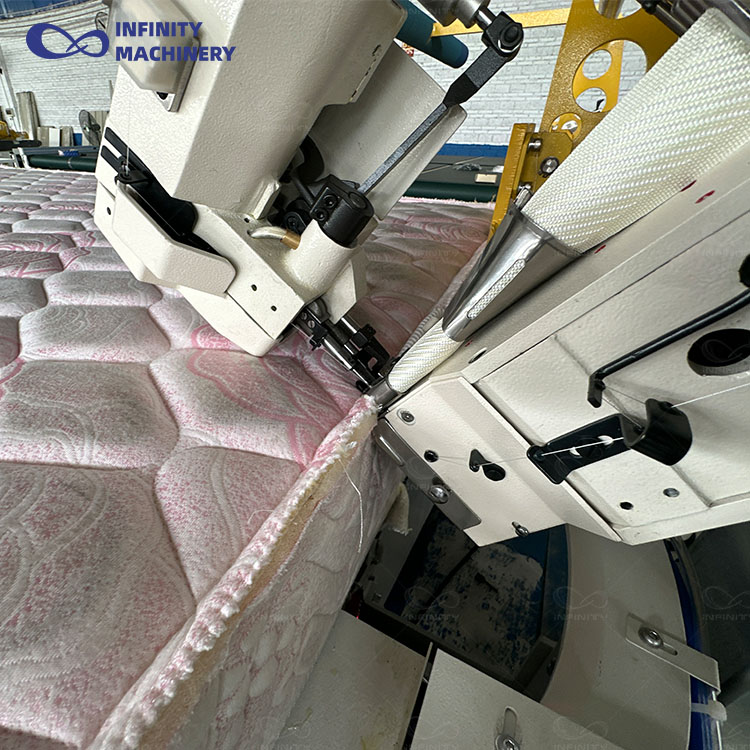
The Mexico commissioning record identifies the machines by function. Our catalog gives model-specific details separately. For example, our IF-T4 tape edge machine handles a listed mattress thickness of 150 to 450 mm. Its conveyor advances the mattress past a fixed sewing head, turns it at the corners and flips it for the second face. A factory making 100 mm toppers as well as 350 mm hybrids should identify the thin product in the enquiry so we can specify how each will be sewn.
A panel project starts farther upstream. One Infinity layout pairs an IF-QM1 quilter, an IF-4BF four-side finishing machine and an IF-QFS stacker in an equipment envelope of about 12.9 × 5.0 m. Roll loading, stack removal and service access need space beyond that drawing. If quilted panels already arrive cut and hemmed, your investment can go straight to closing and packing. Explore the mattress panel line.
2. Mert Makina
Mert Makina began building mattress machinery in 1993 in Türkiye and operates in Kayseri. Its M-2800 automatic tape edge and packaging line is worth considering when an existing plant wants to move bulky mattresses between closing and wrapping by conveyor. Cross conveyors and turning tables let a layout change direction around a column or a wall.
A film change at the packer can hold up two sewing stations upstream. The drawing should show how many finished beds can queue, how a different size can pass through, and which station restarts the transfer. On a low-volume floor that rarely moves more than one mattress at a time, a full conveyor loop may occupy space you need for orders ready to ship.
3. Hennecke
Hennecke, founded in 1945 and headquartered in Sankt Augustin, Germany, builds the JFLEX EVO for continuous slabstock foam production. Its adjustable foaming width is 1,550 to 2,300 mm. The line itself occupies approximately 54 m² and has a rated output of up to 120 kg/min. To translate that rating into finished king-size layers, the converter needs the foam density, layer dimensions and cutting yield.
Size the foaming project from the weight of saleable layers you need, allowing for trim at cutting. A company buying cured blocks can order a cutter on its own. A company bringing foam production in-house also needs the facilities and specialist staff for raw-material handling, block storage and curing. Lay out those areas before using the machine footprint to estimate the building size.
4. Bäumer
Bäumer began in Wuppertal in 1919 and rebuilt in Freudenberg, Germany, in 1946. Its OFS-Queensize uses a circulating knife to cut horizontal contours across a working width of 3,400 mm. The wide bed is useful when two or more blocks can share a cutting program or when a wide order would otherwise need separate passes.
Take a profile with a narrow valley and your softest production foam. Measure the remaining thickness at that valley on pieces cut near both edges and at the center. Then fit the actual order quantities onto the block. A fast cut can still leave a long strip too narrow for the next product. For a factory making only flat slabs, ask for a straight splitting trial before committing to contour equipment.
5. Masias Maquinaria
Masias Maquinaria of Sant Joan les Fonts, Spain, supplies fiber preparation and web-forming equipment. Its mattress systems can blend natural, synthetic or recovered material for felt and wadding. One configuration feeds a formed pad directly to a multi-needle quilter, eliminating an intermediate wadding roll. This is a route for a plant with sufficient demand to make its own fill.
A fiber line can run in kilograms per hour while the quilter consumes square meters. A 2 m wide web at 300 g/m², moving at 10 m/min, uses 6 kg/min, or 360 kg/h, before trim. Use your real width and fill weight to size the feed. With recycled material, compare samples from the center and edges for weight and loft. A good average weight can hide a thin edge that shows through the ticking.
6. Spühl
Spühl in Wittenbach, Switzerland, dates to 1877. Its Fides FPA-300 assembles preformed strings of pocket springs into cores. It can build parallel or nested rows and zoned units, with glue applied at the center or at the top and bottom. The published working range includes pocket heights of 70 to 230 mm and unit widths up to 2,100 mm.
This makes Spühl a useful comparison for a factory keeping its existing coilers. Check the waist diameter, fabric seams and pocket height of those strings against the assembler tooling. The FPA-300 specification gives up to 18 assembly cycles per minute, depending on the spring dimensions. Ask for a timed run of a complete core with your row count and zoning sequence. The supplier also notes that changes in coil specification may require additional tools, so price the second spring family in the initial bid.
7. Lianrou
Guangzhou Lianrou began as a mold manufacturer in 1978. Its LR-PSA-GLL line uses ultrasonic welding to join pocket spring units without adhesive. Here the weld replaces the adhesive between neighboring spring rows. It matters to a manufacturer developing a core with a glue-free specification or trying to remove hot-melt consumption from this operation.
Evaluate the joint on the pocket fabric you plan to purchase. Build a core with your zone transitions, compress it according to your product test procedure, and inspect how the row joints and edge rows hold up. Compare fabric and tooling costs alongside adhesive savings. A mattress with a welded spring core may still use adhesive in its foam rails or comfort layers. The construction drawing should define the extent of any glue-free product claim.
8. Belmac
Belmac in Forlì, Italy, supplies the BM 100 for open-coil Bonnell production. It knots both ends of the wire and heat-treats the spring after forming. Its rated maximum is 85 springs/min. The permitted height depends on the turn count. For example, the five-turn range is 120 to 150 mm and the seven-turn range is 160 to 180 mm.
A plant buying complete Bonnell units would also need a way to assemble the loose springs. Before pricing those stations, match the end-ring diameter and wire gauge to the existing unit drawing. Floor planning deserves attention here. Belmac gives a 6.0 × 1.4 m machine footprint and an 8.0 × 3.5 m operating area. Ordering on the smaller dimensions alone can leave the wire supply or the operator without clearance.
9. Amelco Industries
Amelco in Strovolos, Cyprus, addresses a different shipping job from retail mattress packing. Its RL2000PRE pre-compresses spring units before feeding them into a roll bale. It handles units up to 22 cm high, including Bonnell and pocket types. That makes it relevant for a spring producer shipping unfinished units to another factory, or a group moving cores between plants.
Amelco gives an expected 10 to 12 bales per hour, dependent on units per bale. Specify the core size, count per bale and receiving plant's unloading equipment before converting that figure to freight cost per core. Include the receiving end in the trial. A dense outbound bale only pays if the assembly plant can open it with suitable equipment and recover usable units at its own production rate.
10. Gribetz
Gribetz of Fort Lauderdale, Florida, makes the three-needle-bar Paragon M+ in 90-, 110- and 130-inch widths. The machine has a maximum sewing speed of 1,500 rpm and a recommended 1,250 rpm for tack-and-jump patterns. A panel with frequent jumps and a lofty pillow-top build can therefore give a different hourly output from a simple continuous pattern.
Choose the width for the quilted panel you can actually cut after sewing. Measure the incoming roll, the quilt coming off the machine and the finished panel after trimming. Preserve the selvage and one corner of the sample so the cutting team can see the allowance. A wider quilter earns its cost if it reduces waste or handles a regular wide order. If prepared rolls already queue at the panel cutter, measure cutting and stacking before upgrading the quilter.
11. Atlanta Attachment Company
Atlanta Attachment in Lawrenceville, Georgia, separates two jobs that often appear as one line in a quote. The handle-making workstation (model 1959) cuts and folds the material for each handle. A second machine, the dual-tack workstation (model 1353M), attaches the finished handle to the mattress border. A factory buying finished handles may have good reason to buy only the attachment workstation.
Test the handle that causes the most rework. A thick filled handle and a thin fabric tab can sit differently against the same border. Mark the required centers on a sidewall cut to production length. Inspect the fold, attachment spacing and any puckering after sewing. If a separate station later closes the border, measure position from the finished seam. A handle centered on a flat strip can end up visibly off-center on the bed.
12. MPT Group
MPT Group in the UK makes the BordaTac S4 for simulated hand-side stitching on a mattress or base border. Its four-tack mode is specified at 42 seconds per meter. A 6 m strip would take about 4.2 minutes of stitching at that rate, before loading, cutting and handling. The machine offers different tack arrangements, so timing a display pattern tells you little about a different pattern on the order.
MPT's Autotufter serves another purpose. It applies tufts through the mattress. A decorative sidewall and a through-tufted construction need different equipment even if a customer calls both finishes "tufted." Give the supplier a section drawing and one full-length border. For the S4, approve how the pattern meets at the closing seam. For through-tufting, specify the finished mattress thickness, tuft lengths and layout.
13. Elektroteks
Elektroteks in Bursa, Türkiye, supplies the WBX-400 Series roll-coating system. It can set adhesive quantity by layer and handle changes in foam thickness, including contoured material. Its listed minimum glue consumption is 30 g/m², dependent on the material. On a 2.0 × 1.6 m face that works out to 96 g at that setting. The figure is per coated face, before startup waste.
A heavier coating can alter drying time and leave the next operation waiting. Weigh an actual foam sample before and after coating, then check the bond after the agreed cure interval. The optional infrared heater and feeding robot affect capital cost and floor layout. Keep them visible in the quotation so a basic coater and a more complete cell can be compared at the same accepted output.
14. Dolphin Pack
Dolphin Pack, founded in 1974 and based in Affi, Italy, supplies the Ander Roll for a mattress or topper that an operator has already placed in a preformed polyethylene bag. The Pressa + Ander Roll configuration adds compression. This setup can suit a plant that already bags its products and wants a smaller package for selected orders.
Time the entire packing job. Lay out a fresh bag, load the largest mattress, run the roll cycle and put the product in its carton. A stopwatch started at the roller misses the work that determines staffing. For mixed retail and online orders, price flat packing as a separate route. Some constructions or retailers may require a flat delivery even when other models travel rolled.
15. C³ Corporation
C³ Corporation in Wisconsin, USA, supplies the CF1396 compression folding system. Depending on the package, the mattress can be bagged, compressed and rolled, or folded before rolling. In one C³ example a four-layer king foam mattress produced a package 17 inches in diameter and 40 inches high. That example gives a carton designer something concrete to discuss. A different foam stack or spring edge can change both dimensions.
Choose this type of system when the same packing department has to produce several package formats. List the share of orders going out flat and the share going into cartons, then run that mix during the demonstration. Record film changes, label placement and carton loading. The packing machine can be ready for another bed while the previous roll is still waiting for a box.
Which suppliers fit your factory?
The component you already buy sets the starting point. A spring plant's finished product is another factory's raw material. Put a line on the process drawing where your supplier's responsibility begins and another where an accepted mattress, panel or core leaves it.
A new factory buying cores and quilted panels
Start with the mattress construction. For a tape-edged bed, you need a way to prepare the border and close both faces. For a zip-covered foam bed, cover sewing or fitting takes the place of tape edging. Both routes still need inspection and packaging. Infinity or Mert can discuss the transfers in a multi-station project. Atlanta Attachment makes more sense if the only missing operation is attaching handles to an otherwise finished border.
A first purchase can be quite small. Give each bidder the daily mix by size, the tallest build and the number of people available on the closing shift. If the proposal includes a quilter, identify which purchased component it would replace and how much of that component you buy each month.
A foam converter adding a mattress line
Choose Hennecke for a discussion about producing the block, Bäumer for contour cutting, and Elektroteks for bonding cut layers. A converter that already buys cured foam may only need the latter two stages. In El Salvador, our team visited a factory to look at its existing foam processing and the space available for new equipment. See the foam factory consultation.
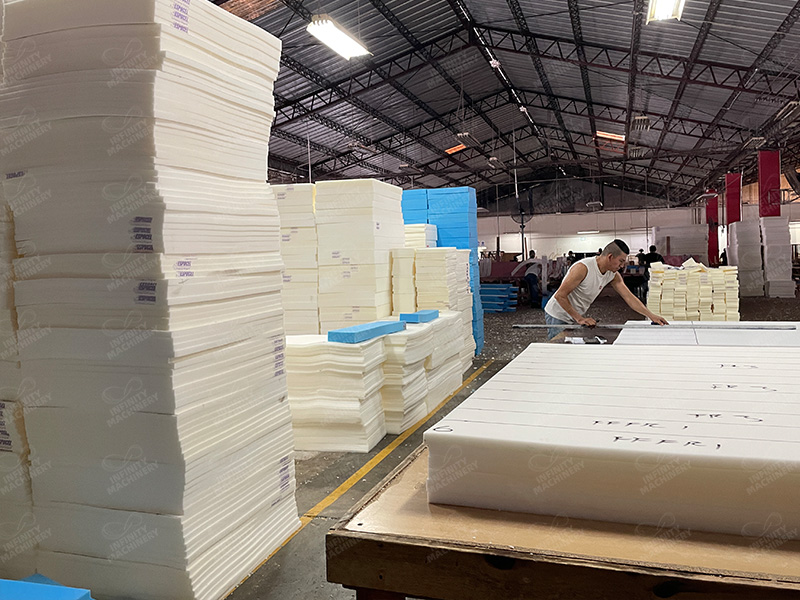
For the cutting trial, use the block you receive from your supplier, including its actual edge condition. For the bonding trial, use the deepest contour and your production adhesive. A quotation based on clean rectangular pieces can miss both trimming loss and the time operators spend positioning a profiled layer.
A spring plant bringing pocket cores in-house
Separate coiling capacity from assembly capacity. Infinity's IF-P130-1 single-wire pocket coiler is rated at 130 springs/min for an indicated wire range of 1.6 to 2.3 mm. For a 780-spring design, one machine running continuously at that speed makes the equivalent of 70 cores' worth of springs in 420 minutes. The assembler must still join the rows. Reels, rejected strings and changes between models use part of the available time.
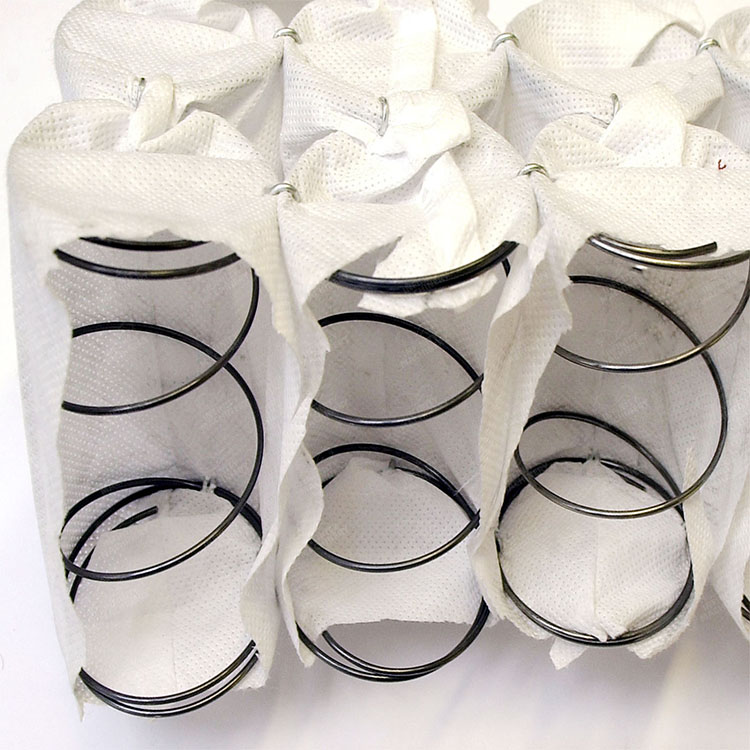
A glued unit and a welded unit may require different pocket material and downstream handling. Compare a Spühl assembly proposal with the coilers you intend to keep. Evaluate Lianrou against the complete glue-free core design. If the customer's drawing calls for a Bonnell unit with helical connections, begin with Bonnell coiling and assembly equipment.
An established plant missing its shipping target
Measure the slowest handoff over a representative shift. Shipping 200 mattresses in 420 net minutes requires an accepted bed every 2.1 minutes on average. A solitary packing station taking three minutes per bed can process at most 140 in that window, even if sewing supplies every bed on time. Add a packer, change the packing method or reduce handling only after timing the queue.
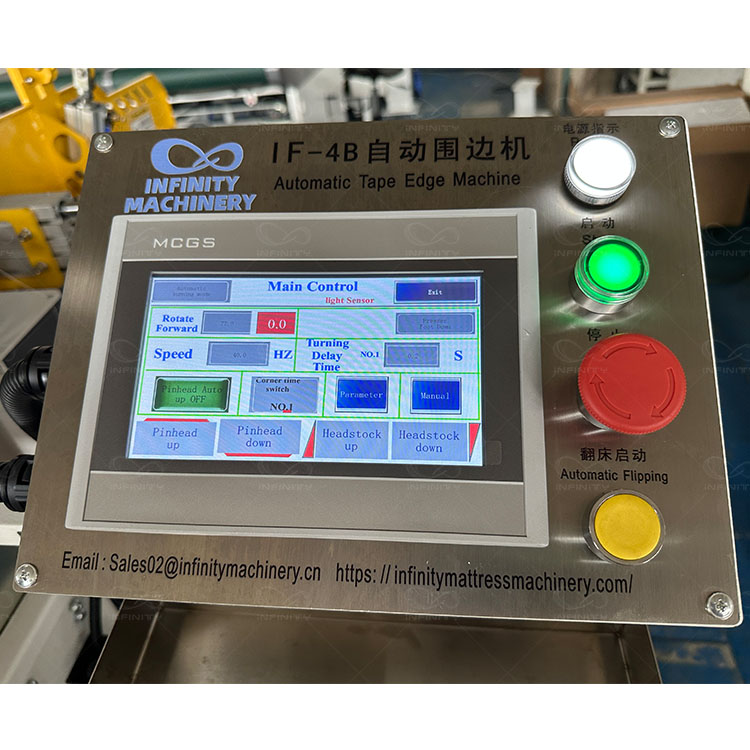
If the queue is at sewing, record time for corners, flipping, thread changes and rework. A time study of straight seams alone will make a closing station look faster than it runs. Estimate tape edge output per shift.
What does mattress manufacturing equipment cost?
For a first budget meeting, allow roughly US$30,000 to $60,000 for a starter quilting and semi-automatic closing package. Bringing panel cutting and spring assembly into the project moves the indicative equipment budget into six figures. A fully automated factory needs a line-by-line proposal tied to its floor plan. These are Infinity's published 2025 planning examples. Obtain a current quote for your destination and configuration.
| Planning package | Indicative equipment budget | What is in scope |
|---|---|---|
| Starter sewing room | US$30,000 to $60,000 | Starter quilting equipment and semi-automatic tape edging. |
| Panel and spring assembly | US$100,000 to $200,000 | Quilting, tape edging, a panel cutter and spring assembly. |
| Automated industrial plant | US$350,000 and up | Automated lines with CNC integration, conveyors and robotics. The station list determines the total. |
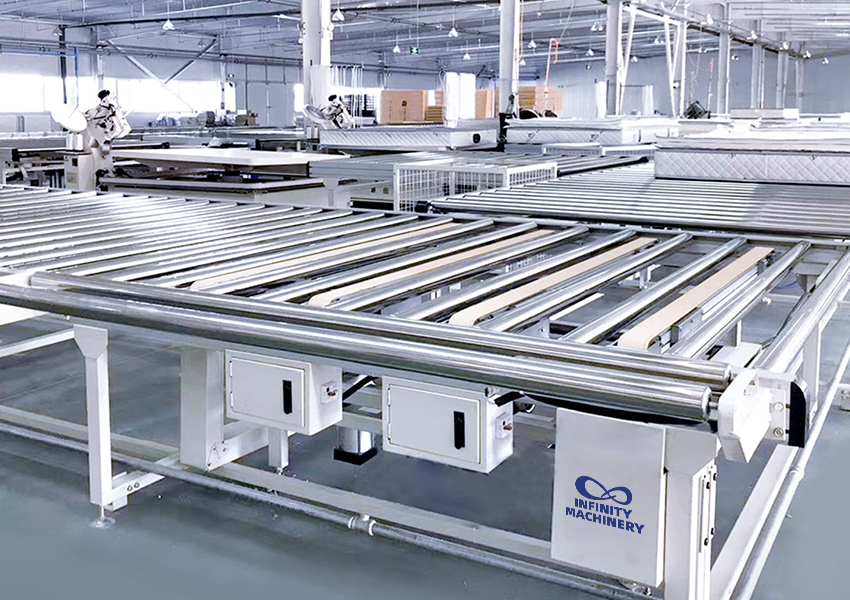
The starter package may already be too broad if all your panels arrive quilted. Conversely, a spring assembler in the middle package still needs pocket spring strings, whether purchased or produced in-house. The equipment investment guide gives the package context. The ranges do not establish delivered prices or the cost of land, buildings, operating stock or working capital.
Put two quotations on the same delivered basis
| Illustrative line item | Vendor A | Vendor B |
|---|---|---|
| Machine package | $40,000 | $34,000 |
| Transfer equipment | Included | $4,500 |
| Commissioning | Included | $3,000 |
| Comparable subtotal before freight and tax | $40,000 | $41,500 |
In this US-dollar example, Vendor B's machine starts $6,000 lower. Transfers and commissioning bring its subtotal to $41,500, or $1,500 above Vendor A. Before awarding the order, add the items that can differ by origin or destination. Examples include export packing, freight, import charges, local rigging, power and air connections, technician travel and spare parts. Ask each bidder to quote in the same currency for the same destination. Specify the Incoterms® rule, its edition and the named place.
Work out what each accepted unit will cost
For a roll packer, count film used for failed seals and rejected packs as well as good ones. For a foam cutter, weigh the usable layers and the offcuts from one block. For a quilter, record saleable panels after trimming. Use the same product mix for both trials.
Running cost per accepted unit = (shift labor + energy + consumables + maintenance allowance) ÷ units that pass inspection.
Keep capital recovery on a separate line. If a US$12,000 option saves $0.60 per accepted mattress, it needs 20,000 mattresses to recover its price before financing and tax. At 5,000 qualifying mattresses a year that takes four years. Use only the models on which the option actually saves money.
Which safety and compliance documents belong in the order?
Name the installation country and intended use on the purchase order. The machine builder supplies equipment evidence. The factory also has duties as an employer, and the company selling the mattress has obligations for the finished product. These are three separate reviews.
A US installation
For a US workplace, OSHA's general machine-guarding rule, 29 CFR 1910.212, covers hazards such as points of operation and ingoing nip points. A cutter, a powered roller transfer and a compression press present different access points. Ask for the guard layout on the exact configuration being offered, including the gap between machines supplied by different companies.
During servicing, unexpected startup or the release of stored energy can expose maintenance staff to injury. OSHA's 29 CFR 1910.147 covers hazardous energy control for applicable servicing and maintenance. Obtain the electrical and pneumatic drawings and have the site's qualified personnel review isolation points and procedures before handover.
A machine going into the European Union
The European Commission's machinery guidance identifies Machinery Directive 2006/42/EC as the framework for machinery placed on the EU market before 20 January 2027. Under Article 54, Regulation (EU) 2023/1230 generally applies from 20 January 2027. A late-2026 purchase order can therefore involve a 2027 placement on the market. Record the expected placement date and ask which declaration and instructions accompany the machine.
For a line with several builders, identify who takes responsibility for the assembled installation and the safety functions across transfers. Match the supplied paperwork to the model and configuration delivered. A logo on a quotation gives the engineering team little to review.
US flammability requirements for the finished mattress
For the US market, 16 CFR part 1632 addresses smoldering ignition of mattresses and mattress pads. 16 CFR part 1633 covers the open-flame performance of mattress sets. The US Consumer Product Safety Commission's mattress guidance explains which products each standard covers. A machine acceptance run measures how the production equipment performs. The applicable finished-product tests evaluate the mattress construction. If a new quilting, adhesive or covering process changes that construction, send the change to your product compliance lead before release.
Buying factory-direct, through a local dealer, or from a line integrator
The best service arrangement depends on what a stopped machine interrupts. A plant with two tape edge stations can sometimes keep shipping while one is serviced. A plant with one packer and a retailer collection booked for the following morning has much less room for delay.
| Buying route | Where it works well | What to settle in writing |
|---|---|---|
| Direct from the equipment builder | A model needs an unusual spring geometry, sewing head or material trial with the engineering team. | Who commissions overseas, whose parts are stocked near you, and how technician travel is billed. |
| Local dealer or distributor | An existing line needs a compatible station quickly and the dealer has the part or machine in stock. | Who holds the warranty, what is physically in stock, who can change controls and who handles escalation. |
| Multi-machine line integrator | Several builders supply adjacent stations and the plant wants one party to deliver the complete section. | Where each builder's scope ends, who signs the integrated test and who supports the individual machines later. |
Ask each bidder to price a specific recovery scenario. Suppose a tape edge conveyor belt fails on a Friday afternoon. Get the part number, the actual stock location, the cutoff for dispatch, and the person authorized to fit it. "Dispatch in 48 hours" refers to one step. The time until your next accepted mattress also includes diagnosis, transport, installation and a trial run.
The value of local support can be estimated. If a stopped line loses $2,400 in unrecoverable contribution per production day, and a nearby service arrangement genuinely saves two days on an incident, that incident is worth $4,800. A local premium above that may still be worthwhile over the life of the equipment. Check the expected frequency of faults, whether another station can take over, and whether missed production can be recovered on the next shift.
What is changing in mattress machinery in 2026?
Three equipment choices already available can change the scope of a new project. They affect which fabric to qualify, how two stations restart and how many packaging recipes operators must handle.
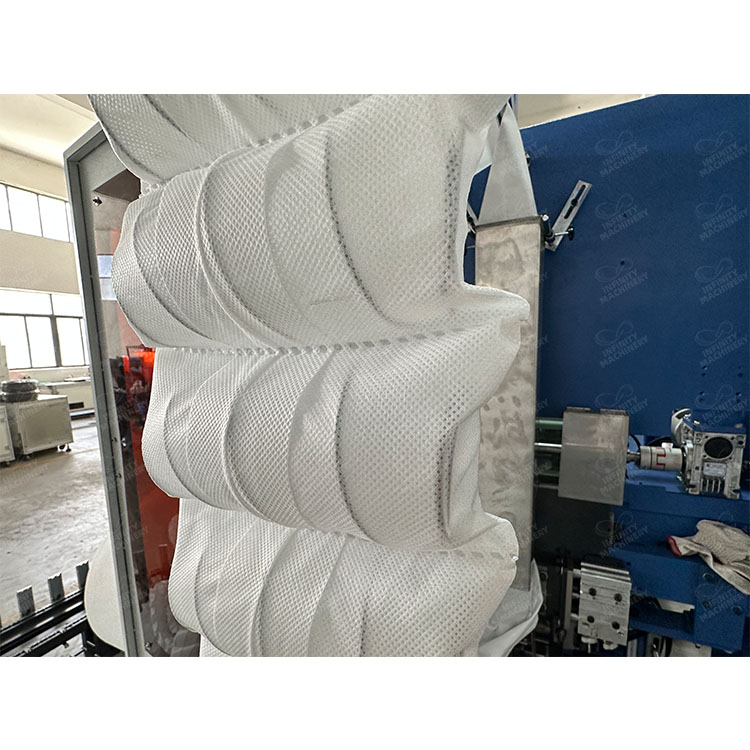
Welded pocket units change the material trial. Lianrou's report from ISPA EXPO 2026 identifies the LR-PSA-GLL glue-free spring unit line among the equipment it exhibited. A factory considering a switch from glued rows needs to qualify the pocket fabric, the row joint and the complete unit under its own test conditions. Obtain prices for a representative month's fabric and adhesive before projecting savings.
Direct feeding ties the batting line to the quilter. Masias can form a fiber pad and feed it to a multi-needle quilter. That can remove intermediate rolls and their handling. The quilter and the fiber line then share a production rhythm. Specify what happens to the fiber feed during a thread break, a pattern change or an unscheduled stop.
Pack recipes can follow the sales channel. A system such as the C³ CF1396 can send some mattresses out bagged and others folded and rolled. Retail replenishment and parcel orders can share machinery if the line can change recipes without a long queue. Test a mixed sequence in the order it actually appears on the shipping schedule.
What to run at the supplier's factory before shipment
Reserve the factory acceptance test when you place the order. Give both teams the drawings, product samples and pass limits in advance. Include your most common mattress and a construction near the machine's working limit. Keep the size change and any restart inside the agreed test window.
| Station | Sample or test | Record for acceptance |
|---|---|---|
| Quilter and panel cutter | Your thickest fill stack, widest panel and most demanding recurring pattern. | Saleable panels per hour, finished dimensions after quilting, pattern alignment and trim waste. |
| Spring coiler and assembler | Actual wire, pocket material, final zoning drawing and a size change. | Accepted cores per hour, row sequence, unit width, rejected strings and tooling required for the next size. |
| Tape edge | Both faces and all four corners on a regular model and the tallest difficult model. | Finished seam coverage, puckering, skipped stitches, rework and elapsed time including the flip. |
| Foam laminator | The usual adhesive, softest layer and a profiled layer in their real stacking order. | Applied adhesive per square meter, acceptable bond after curing, and alignment at the edges. |
| Compression packer | The largest or firmest eligible mattress with its production film and carton. | Sealed dimensions, carton fit, seal integrity, and mattress recovery after the agreed compressed storage period. |
Record settings, operators, elapsed time, material consumed, accepted units and rework. Photograph the agreed sample and keep a labelled piece where practical. If the supplier cannot use your normal voltage, adhesive, film or pocket material during the factory test, write down the substitution and the check that remains for the site test.
Repeat the specified checks after installation, with the factory's utilities and normal operators. List manuals, backups for the delivered settings, wear parts and training alongside the production results. Tie the final acceptance milestone to that signed record.
Frequently asked questions
Which supplier should a small mattress factory approach first?
Start with the work that generates the first saleable bed. A business buying finished cores and quilted covers can ask Infinity or Mert for a closing and packing proposal. A business selling zip-covered foam mattresses may need a cover-fitting and bagging solution instead. Tell the supplier which components arrive ready to use so the first quote covers only the work your staff will do.
Should I buy a complete line from one company?
One integrator is useful where conveyor heights, controls and safety zones cross several stations. For a mature plant replacing a single machine, a specialist can preserve the value of equipment you already own. In either case, put the interfaces on the drawing and name the party responsible for the first accepted piece through the entire section.
How do I compare supplier lead times?
Ask for dates measured from the same starting event, such as approval of a signed drawing and receipt of the deposit. Separate machine completion, factory testing, port departure, arrival at the plant and the first accepted batch. If retailer deliveries depend on a specific week, include customs, unloading and technician availability in the schedule.
Can I fold or roll every mattress I make?
Qualify each construction and package combination. Spring edges, foam firmness, adhesive cure and the time spent compressed can affect recovery. Measure the outgoing roll and the unpacked mattress at an agreed interval. A parcel packaging test answers a separate question about transport damage. ISTA Procedure 3A covers qualifying packaged products weighing up to 70 kg (150 lb) in parcel delivery. ISTA Procedure 3B covers packaged products shipped less than truckload.
What is a sensible first spare-parts order?
Start with components whose failure would stop your particular station. For a tape edge unit, have the builder identify the needles, belts or other wear items for the specified sewing head and drive. Match the numbers to the parts manual, record which can be sourced locally, and ask for a price and lead time for the longest-lead component. Set the stock quantity from usage and replenishment time.
What should I send to get comparable quotations?
Send the mattress cross-section, minimum and maximum dimensions, finished weight, production mix, accepted units required per net shift, utilities and a floor plan showing doors, columns and adjacent stations. For a packer, include the carton and the storage interval before unboxing. For a quilter, add a full material stack and the customer's pattern file.
For example, a buyer expanding a hybrid line could send this brief. "We buy quilted panels and pocket cores. We need to close and pack 120 hybrids in seven net production hours, with three size changes. Attached are the tallest mattress, its border and tape, the carton drawing and our workshop plan. Please quote the stations, transfers, trial, training and a wear-parts kit separately." For a configuration based on your own products, send the brief to Infinity Mattress Machinery.
References and sources
- Equipment budgeting. Infinity Mattress Machinery, equipment investment guide. The starter, intermediate and industrial equipment examples used in the budget comparison.
- Installation and equipment. Infinity Mattress Machinery, Mexico installation. Commissioning scope and sequence for hemming, tape edging and packing.
- Coiling specification. Infinity Mattress Machinery, IF-P130-1. Individual spring production rate and wire range used in the shift calculation.
- International delivery. International Chamber of Commerce, Incoterms® rules. Division of delivery tasks, costs and risks between buyer and seller.
- US machinery safety. OSHA, general machine guarding. General guarding requirements for machinery in US workplaces.
- US maintenance safety. OSHA, control of hazardous energy. Requirements for applicable servicing and maintenance activities.
- EU machinery framework. European Commission, machinery legislation. EUR-Lex provides the official texts of Machinery Directive 2006/42/EC and Regulation (EU) 2023/1230. Both links open PDFs. Article 54 of the regulation gives the application dates.
- US mattress flammability. CPSC, mattresses, mattress pads and mattress sets. 16 CFR part 1632 covers smoldering ignition. 16 CFR part 1633 covers the open-flame test for mattress sets.
- Shipping tests. International Safe Transit Association, test procedures. The association provides separate overviews of Procedure 3A for parcel delivery and Procedure 3B for less-than-truckload shipments.
